What are AI search optimization tools?

Your next customer probably won’t find you on page one of Google. They’ll ask ChatGPT, Perplexity, or Gemini something like “What’s the best onboarding tool for a 50-person SaaS team?” and get a short list of three or four names. If your product isn’t on that list, you’ve lost the deal before your sales team even knew it existed.
That’s the problem AI search optimization tools are built to solve. Traditional SEO tools still tell you where you rank, but they can’t tell you whether an AI model mentions your brand, cites your content, or recommends a competitor instead. This guide explains what AI search optimization tools are, how they work, and how SaaS teams can use them to build real AI visibility.
What Are AI Search Optimization Tools?
AI search optimization tools are software platforms that help brands measure and improve how often they’re mentioned, cited, and recommended in AI-generated answers. They track your presence across answer engines like ChatGPT, Perplexity, Gemini, Claude, Microsoft Copilot, and Google AI Overviews, and many also support traditional SEO work like content optimization and rank tracking.
You’ll see this category described with several overlapping terms:
- Generative engine optimization (GEO): getting your brand and content cited inside answers that generative AI writes. Generative engine optimization tools focus on this.
- Answer engine optimization (AEO): structuring content so AI assistants pick it as the direct answer to a question.
- AI SEO: a broad label for using AI in SEO, or optimizing for AI search.
- LLM visibility (or AI visibility): the metric itself, meaning how visible your brand is inside large language model (LLM) responses.
In practice, most vendors and marketers use these terms interchangeably. Whatever the label, the goal is the same: make sure that when buyers ask AI about your category, your brand shows up, and shows up accurately.
Why AI Search Matters for SaaS Companies
Software buyers have already moved their research into AI chat. A March 2026 G2 survey of 1,076 B2B software buyers found that 51% now start their research with an AI chatbot rather than a search engine. The top use case was comparing vendors’ strengths and weaknesses, which is exactly the shortlisting stage where deals are won or lost.
Tech buyers lead this shift. Responsive’s research found that 80% of technology buyers use generative AI at least as much as search for vendor research, 21 points higher than other industries.
Google itself is now an AI answer engine too. Google announced at I/O 2026 that AI Overviews passed 2.5 billion monthly users. So even buyers who never open ChatGPT are reading AI-written summaries before they see a single blue link.
For SaaS companies, this changes what search visibility means:
- Shortlists form inside the answer. Prompts like “best CRM for startups” or “[competitor] alternatives” return a handful of named products. Missing from that answer means missing from the deal.
- Clicks drop, but influence doesn’t. Many AI answers are zero-click, so traffic alone undercounts your impact. Treat AI visibility as a brand-awareness and demand-generation metric, not just an SEO traffic metric.
- Accuracy matters. An AI model that describes your pricing, features, or ideal customer incorrectly can push buyers away quietly.
AI Search Optimization Tools vs Traditional SEO Tools
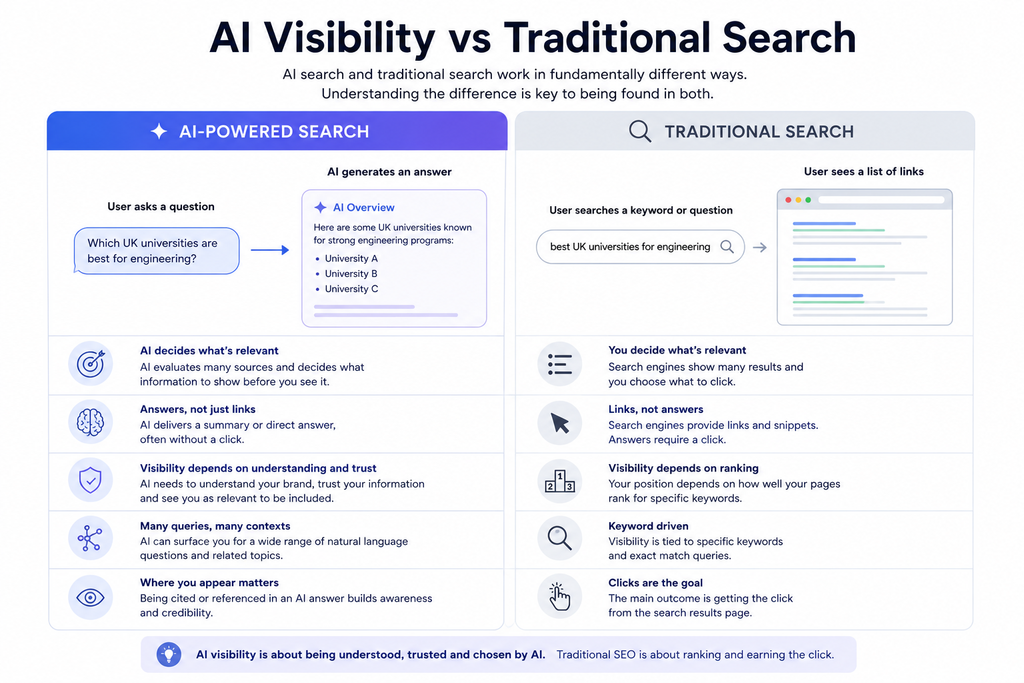
Traditional SEO tools measure how your pages perform in search engine results pages. AI search optimization tools measure how AI systems talk about your brand. The difference shows up in almost every metric:
| Traditional SEO tools | AI search optimization tools | |
|---|---|---|
| Unit of research | Keywords | Prompts and questions |
| Core metric | Rankings and organic clicks | Brand mentions, citations, and share of voice |
| Where results appear | Google and Bing results pages | ChatGPT, Perplexity, Gemini, Claude, Copilot, AI Overviews |
| Competitive view | Who outranks you | Who gets recommended instead of you |
| Quality signal | Backlinks and authority | Cited sources, sentiment, and accuracy |
These two toolsets work together; one doesn’t replace the other. Strong rankings, quality backlinks, and topical authority still influence which sources AI models retrieve and cite. Think of traditional SEO as the foundation and AI search optimization as the layer that shows whether that foundation is turning into AI visibility.
The Main Types of AI Search Optimization Tools
Not every tool in this space does the same job. Some only measure AI visibility, some help you create or improve content, and some fix the technical issues that stop AI crawlers from reading your site. Most SaaS teams end up combining two or three categories.
AI Visibility and Citation Trackers
These tools answer the most basic question: does AI mention us? They run your target prompts across multiple LLMs, then report how often your brand appears, which competitors show up beside you, and which URLs get cited as sources. Examples include Peec AI, Otterly AI, Scrunch, and Goodie AI.
Prompt Research Tools
Prompt research is the AI-era version of keyword research. These tools surface the questions buyers actually ask AI models, so you can track and optimize for real buyer prompts instead of guessing. Many visibility platforms now include prompt research, and question-mining tools like AlsoAsked help fill the gaps.
Content Optimization Tools
Content optimization tools help you write and refresh pages that are easy for both search engines and LLMs to understand, quote, and cite. Surfer SEO, Clearscope, and Frase are long-standing options that now include AI search features. Writesonic combines content creation with GEO tracking.
Technical and Schema Tools
AI models can only cite what their crawlers can access and parse. Technical tools check crawlability, structured data (schema markup), page speed, and whether AI bots like GPTBot can reach your content. Crawlers like Screaming Frog, plus your own server logs, are the usual starting point.
All-in-One SEO Suites With AI Visibility Features
The major SEO platforms have added AI visibility tracking to their existing toolkits. Semrush One and Ahrefs Brand Radar let you monitor AI mentions alongside rankings, backlinks, and keyword data. For teams already paying for one of these suites, this is often the easiest place to start.
How AI Search Optimization Tools Work
Most AI visibility platforms follow the same basic loop:
- Build a prompt set. You (or the tool) define the questions your buyers ask, such as category, use-case, comparison, and “alternatives” prompts.
- Run the prompts across AI models. The tool queries ChatGPT, Perplexity, Gemini, Claude, Copilot, and Google’s AI features on a regular schedule.
- Parse every answer. It records which brands were mentioned, in what order, with what sentiment, and which URLs were cited as sources.
- Roll it up into metrics. Results become visibility scores, share of voice against competitors, citation counts, and trends over time.
- Recommend actions. Better tools point to content gaps, sources worth earning a mention on, and pages that need updating.
One important caveat: AI answers aren’t fixed. The same prompt can return different brands from one run to the next, and each model behaves differently. That’s why trends across weeks matter far more than any single snapshot. If a tool shows you one screenshot of one answer, treat it as a sample, not as the truth.
Key Features SaaS Teams Should Look For
When you compare AI search optimization tools, these features separate useful platforms from simple dashboards:
- Multi-model coverage: tracks ChatGPT, Perplexity, Gemini, Claude, Copilot, and Google AI Overviews, not just one engine.
- Prompt-level tracking: shows results for each individual prompt, so you know exactly where you win and lose.
- Citation and source analysis: lists the specific URLs and domains AI cites for your prompts. This is often the most actionable data in the tool.
- Competitor benchmarking: measures your share of voice against the SaaS brands you actually compete with.
- Actionable recommendations: suggests content updates and topic gaps, not just charts.
- Attribution: connects AI referral traffic to GA4 or your CRM, so you can tie AI visibility to signups and pipeline.
Match the tool to your stage. Early-stage SaaS teams can start with a free checker like HubSpot’s AI Search Grader, or the AI features already in their SEO suite. Scaling teams with a dedicated content and SEO function usually get more value from a specialized platform with deeper reporting.
How a SaaS Brand Can Use These Tools Step by Step
A tool is only as useful as the workflow around it. Here’s a practical process a SaaS marketing team can run every month:
- Write 30–50 buyer prompts. Mix category prompts (“best help desk software”), use-case prompts (“help desk for Shopify stores”), comparison prompts (“Zendesk vs Freshdesk”), and alternatives prompts (“Intercom alternatives”). Use your sales call notes; real buyer language beats invented keywords.
- Get a baseline. Run the prompts through your AI visibility tracker and note where you appear, where competitors appear, and where nobody from your space appears.
- Study the cited sources. Look at which pages AI models cite for each prompt. You’ll usually find a mix of review sites, comparison articles, “best tools” listicles, industry blogs, and community threads.
- Improve your owned content. Update product, comparison, and use-case pages with clear, specific, quotable answers. Add structured data, fresh stats, and FAQ sections that match real buyer questions.
- Earn mentions where AI is already looking. This is the step most teams skip. If an AI model keeps citing a particular listicle or industry blog, getting your product accurately featured on that page is one of the most direct ways to improve your LLM visibility. Brand mentions, listicle placements, and partnerships with relevant industry publications all feed the sources AI relies on.
- Re-measure monthly. Compare visibility and share of voice against your baseline, and shift effort toward the prompts and sources that move.
Step five is where off-page SEO and generative engine optimization overlap. The same authority signals that help you rank on Google, such as trusted third-party mentions and relevant backlinks, are often the sources AI models pull from when they build an answer. That’s why link building belongs in your AI visibility plan, not just your SEO plan: every relevant placement you earn on a trusted site is another page an AI model might read and cite.
Common Mistakes When Using AI Search Tools
- Trusting a single snapshot. AI answers change from run to run. Make decisions on trends, not one result.
- Tracking only branded prompts. Of course ChatGPT knows your name when the prompt includes it. The prompts that matter are unbranded category and comparison questions.
- Buying a tracker without a plan. Visibility data is useless if nobody owns the content updates and outreach it points to.
- Ignoring off-page sources. Many AI citations come from third-party sites, not your own blog. Optimizing only your website leaves most of the opportunity untouched.
- Abandoning SEO fundamentals. AI search optimization builds on traditional SEO. Technical health, quality content, and authority still matter.
Frequently Asked Questions
Do I still need traditional SEO tools?
Yes, you still need traditional SEO tools. AI search optimization tools measure brand mentions and citations in AI answers, but they don’t replace keyword research, technical audits, backlink analysis, or rank tracking. Strong organic rankings and authority also influence which sources AI models cite, so traditional SEO remains the foundation. Most SaaS teams use both: an SEO suite for search performance and an AI visibility tool, or the AI features inside that suite, for LLM visibility.
Are there free AI search optimization tools?
Yes, there are free options, but they’re limited. HubSpot’s AI Search Grader gives a quick snapshot of how AI models describe your brand, and some platforms offer free tiers or trials. You can also test manually by running your buyer prompts in ChatGPT, Perplexity, and Gemini. Free tools are good for a first look, but ongoing tracking across many prompts and models usually requires a paid plan.
What is the difference between GEO and AEO?
GEO (generative engine optimization) focuses on getting your brand cited and recommended in long-form, AI-generated answers. AEO (answer engine optimization) focuses on structuring content so AI assistants select it as the direct answer to a specific question. In practice the two overlap heavily, and most generative engine optimization tools support both. Many marketers now use the terms interchangeably.
How do I measure ROI from AI search optimization tools?
Measure ROI by connecting AI visibility to business outcomes. Track share of voice and citation counts for your priority prompts, then monitor AI referral traffic in GA4 from sources like chatgpt.com and perplexity.ai. Add a “How did you hear about us?” field to signup and demo forms, since many AI-influenced buyers arrive through direct or branded search instead of a trackable click.
How often should I check AI visibility data?
Check AI visibility data weekly for monitoring and monthly for decisions. AI answers fluctuate between runs, so daily checks mostly show noise. A weekly glance catches big drops, such as a competitor suddenly replacing you, whilDo I still need traditional SEO tools?e a monthly review of trends shows whether your content and off-page work is actually improving your visibility.
Final Thoughts
AI search optimization tools give SaaS companies something traditional SEO tools can’t: a clear view of how AI models see, describe, and recommend their brand. But the tool itself is only the starting point. The brands that win in AI search pair good visibility data with steady work: clear, citable content on their own site and trusted mentions on the third-party pages AI already relies on.
Start small. Pick your 30 most important buyer prompts, get a baseline, and find out which sources AI cites in your category. That list will tell you exactly where to focus next.
