What are Brand Mentions? Why it matters for SEO

Most SaaS teams I talk to measure off-page SEO in one unit: backlinks. How many did we build this month, what’s the domain rating, did the anchor text land? Those questions still matter, but they leave out a growing part of how search engines and AI assistants decide which software to show buyers.
That missing piece is brand mentions: the times other websites talk about your product by name. When a review site compares you to competitors, when a newsletter recommends you, or when a Reddit thread names you as the tool that fixed someone’s workflow, search engines and large language models notice.
In this guide, I’ll explain what brand mentions are, where SaaS brands typically earn them, why they matter for SEO and AI search, and how to tell a valuable mention from noise. It’s based on what I’ve seen running link building and brand mention outreach for SaaS companies, along with what Google has said publicly on the topic.
What are brand mentions?
A brand mention is any reference to your company, product, or key people on a website you don’t own. It might be a sentence in a blog post, a row in a comparison table, a quote from your founder in a news article, or a recommendation in a forum thread. The mention can include a link back to your site, or it can be your name in plain text.
For a SaaS company, a typical example looks like this: a marketing blog publishes “The 10 best project management tools for remote teams,” and your product is number four, with a short description of what it does and who it’s for. That entry is a brand mention whether or not the publisher links to your homepage.
This article focuses on mentions on indexable web pages: blogs, listicles, review platforms, news sites, and public forums. Social media mentions matter for reputation and customer service, but most are either not indexed or carry nofollow links, so their direct SEO impact is limited. The pages search engines can crawl and AI tools can read are where mentions do their SEO work.
Linked vs. unlinked brand mentions
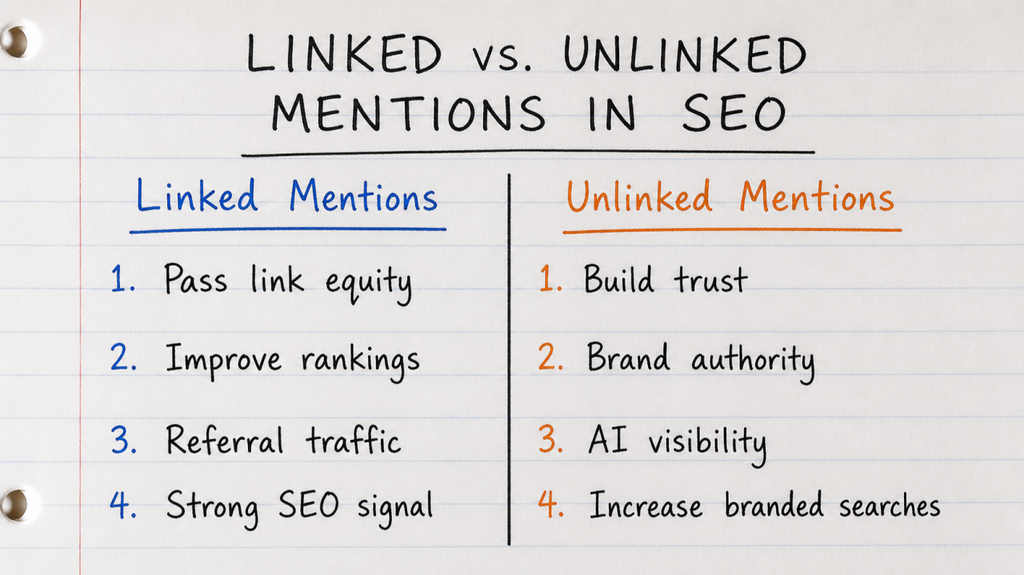
A linked brand mention names your brand and includes a hyperlink to your site. These are the mentions most SEO teams already chase, because they do two jobs at once: they tell readers and search engines who you are, and they pass link equity that can help your pages rank.
An unlinked brand mention names your brand without a link. A journalist cites your survey data but forgets to link it, or a reviewer recommends your tool by name only. These are easy to overlook because standard backlink reports don’t show them. They still shape how your brand is understood online, and as you’ll see later, they’re one of the most efficient sources of new backlinks.
Implied (indirect) brand mentions
Implied mentions reference your brand without using its exact name. Someone might write “that open-source CRM with the purple logo,” or refer to your product by an old name, an abbreviation, or a common misspelling.
These are harder for both people and machines to attribute, and they carry the least SEO value on their own. They’re still worth tracking. If people keep misspelling or shortening your brand, that’s a sign your naming isn’t consistent across the web, which makes it harder for search engines to connect every reference back to one company.
Where SaaS brands typically get mentioned
SaaS buyers research differently from most consumers. They read roundups, compare alternatives, check review scores, and ask peers before they book a demo. That research trail is also where most SaaS brand mentions live:
- “Best [category] software” listicles and roundups
- Comparison and “[competitor] alternatives” pages
- Review platforms like G2, Capterra, and TrustRadius
- Integration and technology partner pages
- Podcast show notes and webinar recaps
- Reddit threads and public community forums
- Industry newsletters and their web archives
Not all of these carry equal weight. In my experience, listicles and review platforms do the most work, because they sit right where buyers look when they compare options. A mention in a well-ranking “best tools” article puts you in front of people at the exact moment they’re building a shortlist.
Those same pages are often the sources an AI assistant draws on when someone asks it for software recommendations. Community threads are close behind: they read as unsponsored opinion, which is why buyers trust them and why AI tools increasingly cite them.
Why brand mentions matter for SEO
Search engines don’t just index pages; they try to understand the things those pages are about. Google calls these things entities (people, places, organizations, and products) and stores what it knows about them in its Knowledge Graph. Every time a credible page mentions your brand alongside your category, your features, or your competitors, it adds evidence about what your company is and where it fits.
It’s worth being precise here, because brand mentions are often oversold. You’ll see articles claim that Google treats unlinked mentions as “implied links” based on a 2012 patent. A patent shows what Google explored, not what it uses, and Google’s John Mueller has said publicly that unlinked mentions aren’t treated like links for ranking. The honest framing is that mentions are a supporting signal that helps search engines understand and trust your brand, not a lever that pushes rankings up on its own. The benefits below are real, but they work alongside content and links, not instead of them.
They build entity and topical authority
When your product is mentioned repeatedly in content about a specific topic, say “customer onboarding software,” search engines learn to associate your brand with that topic. Over time, that association can help your own pages rank for related queries, because Google has more confidence that you’re a relevant player in the space.
This is especially important for newer SaaS brands with generic or ambiguous names. If your product is called something like “Beacon” or “Flow,” search engines need context to separate you from every other use of that word. Consistent mentions next to your category and use case provide that context.
They reinforce E-E-A-T and trust signals
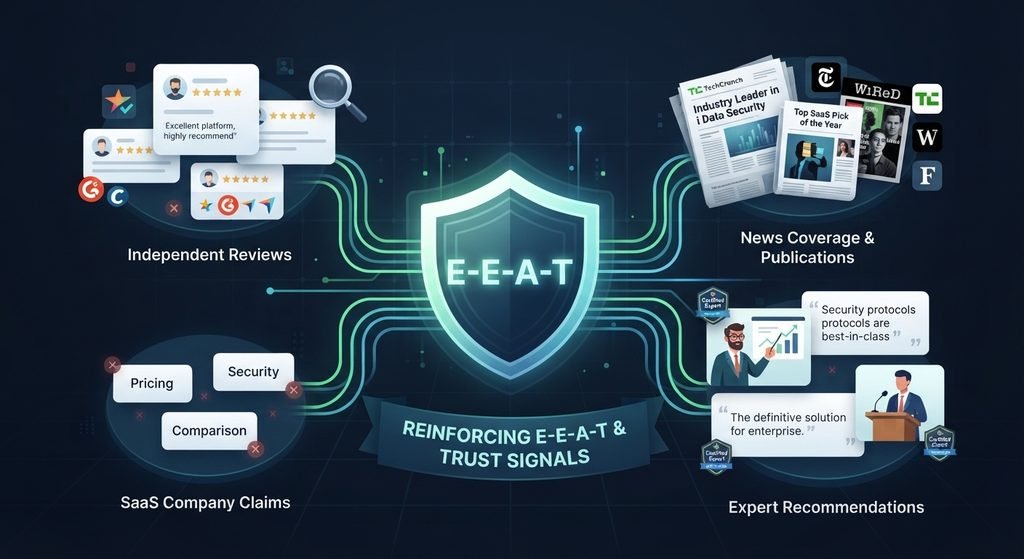
Google’s Search Quality Rater Guidelines ask raters to look at what other sources say about a business when judging its reputation. Independent reviews, news coverage, and expert recommendations are exactly the kind of evidence raters are told to look for. Raters don’t set rankings directly, but the guidelines describe what Google’s systems are designed to reward.
For SaaS companies, this matters most on pages where trust drives conversion: pricing, security, and comparison pages. A brand that’s discussed positively across review sites and industry publications has outside evidence backing up the claims on its own site. A brand that only talks about itself doesn’t.
They grow branded search demand
Every mention is also a small piece of awareness. When people keep seeing your name in roundups, newsletters, and community threads, some of them go to Google and search for you directly. Branded search volume is one of the clearest indicators that your visibility is turning into demand.
Branded searches also tend to convert well, because the searcher already knows what they’re looking for. If you track branded impressions in Google Search Console, you’ll often see them rise after a run of good placements, which is a useful way to connect mention-building work to business results.
They create backlink opportunities
Unlinked mentions are some of the easiest links you’ll ever build. The publisher already knows your brand and chose to write about it, so a short, polite request to add a link is often well received, especially if you point them to a specific page that helps their readers.
In my outreach work, these requests usually convert better than cold pitches because there’s no need to argue for relevance. The mention is already there; you’re just making it more useful. That turns brand mention monitoring into a direct pipeline for link building, not just a reputation exercise.
Brand mentions and AI search visibility
AI assistants like ChatGPT, Perplexity, and Google’s AI Overviews don’t rank pages the way classic search does. They generate answers from patterns across many sources, then sometimes cite a handful of pages. When the web repeatedly says your product is a strong option for a particular use case, those tools are more likely to include you when someone asks a related question.
Industry research points the same way. Ahrefs, for example, analyzed brands appearing in AI Overviews and found that web mentions correlated more strongly with AI visibility than backlinks did. Correlation isn’t proof of cause, but it matches what I see in practice: the brands that show up in AI answers are usually the ones that are talked about widely, not just linked to.
For SaaS, the stakes are high. More buyers now start their research by asking an AI tool something like “What’s the best help desk software for a 20-person team?” If your brand isn’t in that answer, you’re not on the shortlist, and you may never know you were left off because there’s no click to track. Earning mentions in the places AI tools draw from is how you get into that conversation.
Brand mentions vs. backlinks for SaaS SEO
Backlinks and brand mentions do different jobs. Backlinks pass link equity, help search engines discover your pages, and remain one of the strongest signals for ranking on competitive keywords. Brand mentions build recognition: they tell search engines and AI tools what your company is, what it’s known for, and who recommends it.
So the question isn’t which one to choose. A SaaS SEO strategy that only chases links can rank pages without building a brand people search for or AI tools recommend. A strategy that only chases mentions builds awareness without the authority needed to compete on high-value keywords. You need both.
The ideal outcome is a link inside a relevant, positive mention, such as a “best tools” listicle that describes your product accurately and links to it. But don’t reject an unlinked placement on a strong, relevant site just because there’s no link. That mention still feeds your entity signals and AI visibility, and you can often ask for a link later.
What makes a brand mention valuable
Not every mention is worth the same. When I evaluate placements for SaaS clients, I check six things:
- Relevance: Is the site, and the specific page, about your category or audience?
- Authority: Does the site have real organic traffic and a credible reputation?
- Context: Is the mention positive or neutral, and does it describe what you do accurately?
- Consistency: Is your brand name spelled and presented the way you use it everywhere else?
- Indexability: Can search engines crawl the page, and is it actually indexed?
- Placement: Is the mention in the main body content rather than a footer, sidebar, or author bio?
A single mention in a well-ranked, relevant roundup is usually worth more than dozens on unrelated or low-quality sites. It’s read by real buyers, it’s likely to be crawled often, and it’s the kind of source AI tools are more likely to draw from.
Be careful with shortcuts. Mass directory submissions, paid placements on sites that publish anything for a fee, and low-quality AI-generated “best of” lists add little value and can attract the wrong kind of attention from Google’s spam systems. If a site exists mainly to sell placements, its mentions won’t do much for your reputation either.
How SaaS companies can earn more brand mentions
Earning mentions is a mix of outreach, PR, and making things worth talking about. You don’t need to do everything at once. Start with the tactics closest to where your buyers already research, then expand as you see what works.
If your team doesn’t have the bandwidth for ongoing outreach, a link-building partner that specializes in brand mentions and listicle placements can speed things up. That’s the work I do for SaaS brands [link to services page], but whoever you work with, hold them to the quality criteria above.
Get included in “best [category] tools” roundups
Search for “best [your category] software” and “[competitor] alternatives” and note which articles rank on the first page. Those are your priority targets. Reach out to the authors with a short pitch: what your product does, who it’s for, and what makes it different from the tools already on the list.
Make it easy for them to say yes. Offer a ready-to-use blurb, a screenshot, and access to a free trial or demo account. Editors update listicles regularly, so even if the timing isn’t right now, a helpful first contact often leads to inclusion in the next refresh.
Reclaim unlinked mentions
Set up monitoring (more on tools below) and pull a list of pages that mention your brand without linking to you. Prioritize relevant, indexed pages that get real traffic.
Then send a brief, friendly note thanking the author for the mention and suggesting a specific page that would help their readers, such as your pricing page, a feature page, or the original data they cited. Keep it short and don’t make demands; you’re asking a favor from someone who already did you one.
Publish original data worth citing
Journalists and bloggers need numbers to support their arguments. If you publish original research, such as a survey of your users, benchmark data from your product, or an annual industry report, you give them a reason to mention you.
SaaS companies are in a strong position here because they often sit on useful aggregated product data. Anonymized trends like “average onboarding time by company size” can earn mentions for years when they’re packaged in a clear, citable report.
Show up on podcasts, partner pages, and guest posts
Founders and product leaders make natural podcast guests, and most shows publish show notes that mention the guest’s company. Guest posts on relevant industry blogs do the same, while building your team’s visible expertise.
Integration partners are another easy win. If your product connects with other tools, ask to be listed on their integrations or partner pages, and offer to co-promote the integration. These pages are highly relevant, usually well indexed, and read by buyers who already use adjacent tools.
How to track and measure brand mentions
You can’t improve what you don’t see. Google Alerts is a free starting point for catching new mentions of your brand name. For deeper coverage, tools like Ahrefs and Semrush offer brand monitoring that finds mentions across the web and shows whether each one links to you. Dedicated tools such as Brand24 or Mention add social and forum coverage.
For AI visibility, start simple: run the prompts your buyers would use in ChatGPT, Perplexity, and Google’s AI features, and record whether your brand appears and which sources are cited. Repeat this monthly. Several AI visibility tools now automate this tracking if you need it at scale.
To connect mentions to SEO results, track these metrics over time:
- Number of mentions on relevant, quality domains
- Share of voice compared with your top competitors
- Branded search impressions and clicks in Google Search Console
- Referral traffic from pages that mention you
- How often your brand appears in AI answers for your target prompts
Set a baseline before you start a campaign and compare month over month. Mentions compound slowly, so look for trends across a quarter rather than spikes in a single week.
Make brand mentions part of your SaaS SEO plan
Brand mentions aren’t a replacement for content and links, and they won’t move rankings overnight. What they do is build the kind of reputation that search engines and AI tools are increasingly designed to reward: a brand that’s recognized, discussed, and recommended by sources other than itself.
A good first step is to audit where you stand. Look at the roundups and comparison pages that rank in your category, check how often you’re mentioned compared with your top competitors, and run a few buyer prompts through AI tools. The gaps you find become your outreach list.
Frequently asked questions about brand mentions
Here are short answers to the questions SaaS teams ask most often when they start thinking about brand mentions.
If your question isn’t covered here, the sections above go into more depth on each topic.
Are brand mentions a Google ranking factor?
Not directly, in the way backlinks are. Google has said unlinked mentions aren’t treated as links for ranking purposes.
However, mentions help Google understand your brand as an entity, support signals of reputation and trust, and drive branded searches. Those effects can support your rankings indirectly over time.
Do unlinked brand mentions help SEO?
Yes, indirectly. Unlinked mentions build entity recognition, reinforce your reputation, and increase the chance that AI tools recommend your brand.
They’re also a strong source of new backlinks. Because the publisher already chose to mention you, a polite request to add a link often succeeds.
How do I find unlinked brand mentions of my brand?
Use a monitoring tool such as Ahrefs, Semrush, Brand24, or Mention, which can flag mentions and show whether they link to you. Google Alerts covers the basics for free.
You can also search Google for your brand name while excluding your own domain, for example “yourbrand” -site:yourbrand.com, to spot mentions manually.
How long do brand mentions take to impact SEO?
Expect months, not weeks. Search engines need to crawl and process new mentions, and entity signals build gradually.
Most SaaS brands see clearer signs, such as rising branded search and more appearances in AI answers, after three to six months of consistent mention-building.
